Taking Creative Care Exercises

The following activities are shared from an evolving set of resources co-designed with artists, therapists, and people living with long term conditions across Scotland. ‘Taking Creative Care’, funded by Health and Social Care Alliance Scotland, exists to explore Self-Management through the arts, and share simple and creative activities that nurture wellbeing, rest and resilience.
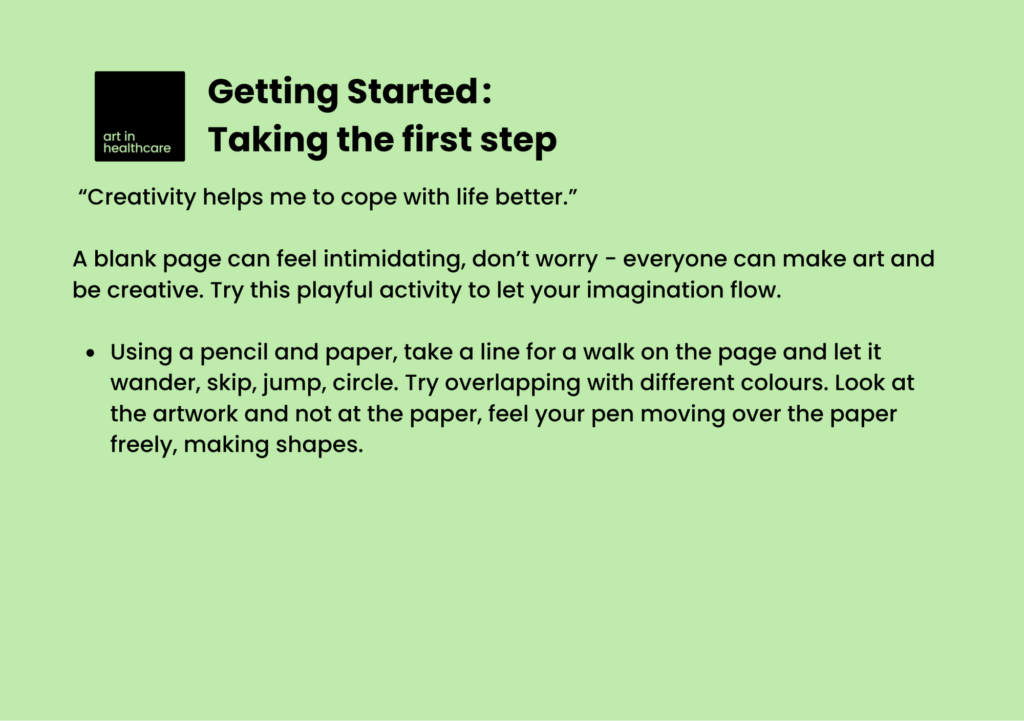
Getting Started: Taking the first step

 “Creativity helps me to cope with life better.” 

A blank page can feel intimidating, don’t worry - everyone can make art and be creative. Try this playful activity to let your imagination flow. 
 
Using a pencil and paper, take a line for a walk on the page and let it wander, skip, jump, circle. Try overlapping with different colours. Look at the artwork and not at the paper, feel your pen moving over the paper freely, making shapes.
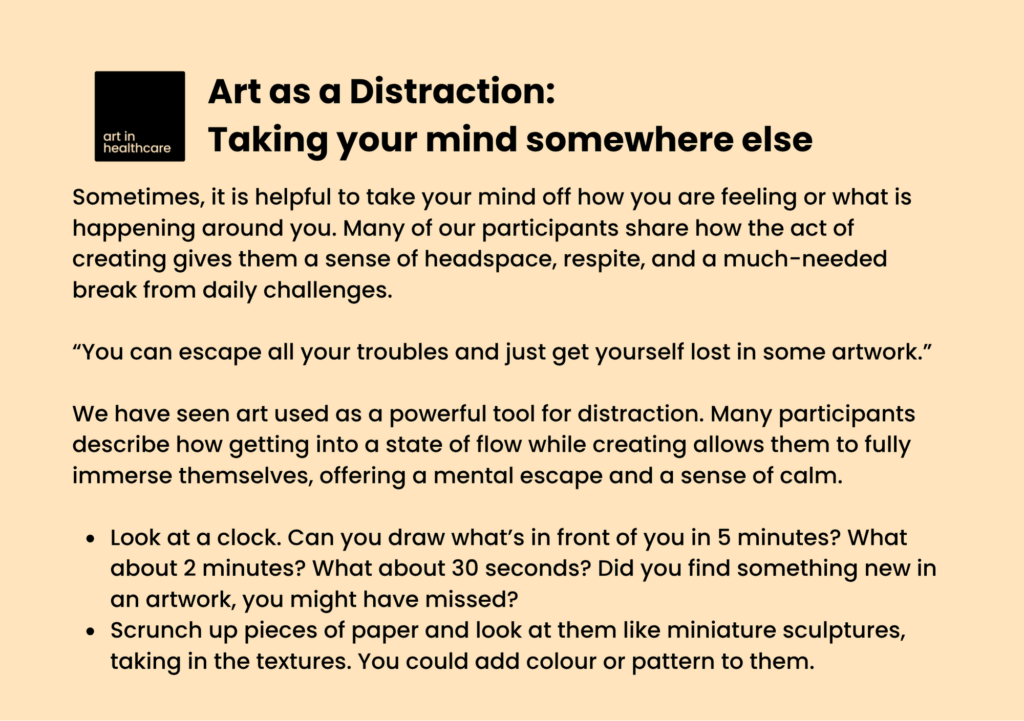
Art as a Distraction: Taking your mind somewhere else

Sometimes, it is helpful to take your mind off how you are feeling or what is happening around you. Many of our participants share how the act of creating gives them a sense of headspace, respite, and a much-needed break from daily challenges. 

“You can escape all your troubles and just get yourself lost in some artwork.”

We have seen art used as a powerful tool for distraction. Many participants describe how getting into a state of flow while creating allows them to fully immerse themselves, offering a mental escape and a sense of calm. 
 
Look at a clock. Can you draw what’s in front of you in 5 minutes? What about 2 minutes? What about 30 seconds? Did you find something new in an artwork, you might have missed? 
Scrunch up pieces of paper and look at them like miniature sculptures, taking in the textures. You could add colour or pattern to them.
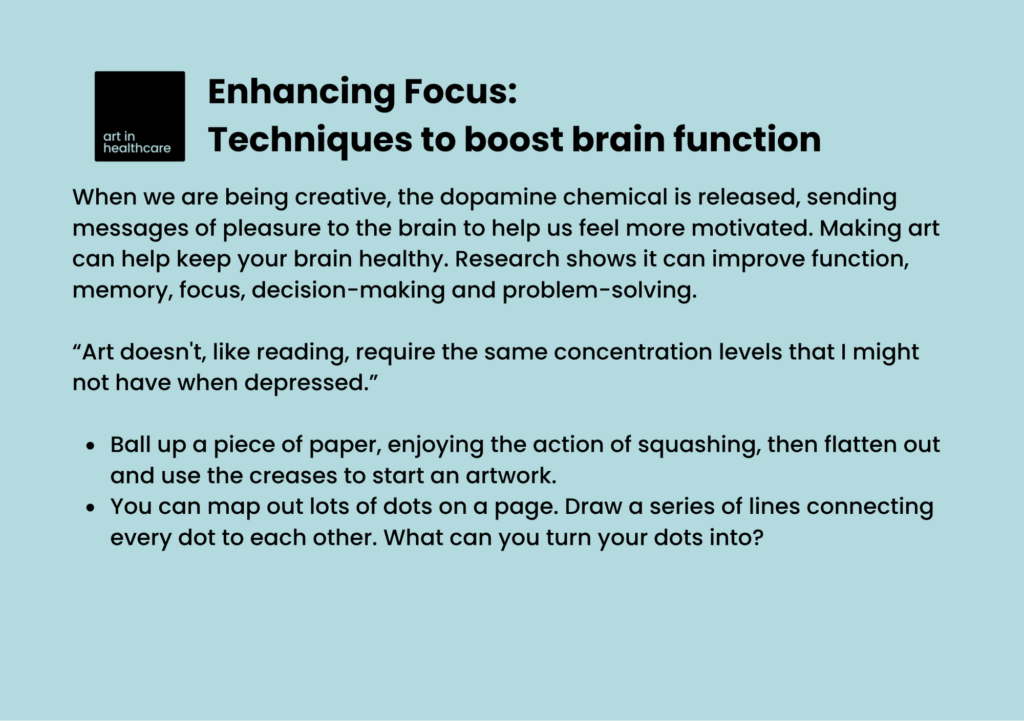
Enhancing Focus: Techniques to boost brain function

When we are being creative, the dopamine chemical is released, sending messages of pleasure to the brain to help us feel more motivated. Making art can help keep your brain healthy. Research shows it can improve function, memory, focus, decision-making and problem-solving.
  
“Art doesn't, like reading, require the same concentration levels that I might not have when depressed.” 

Ball up a piece of paper, enjoying the action of squashing, then flatten out and use the creases to start an artwork. 

You can map out lots of dots on a page. Draw a series of lines connecting every dot to each other. What can you turn your dots into?
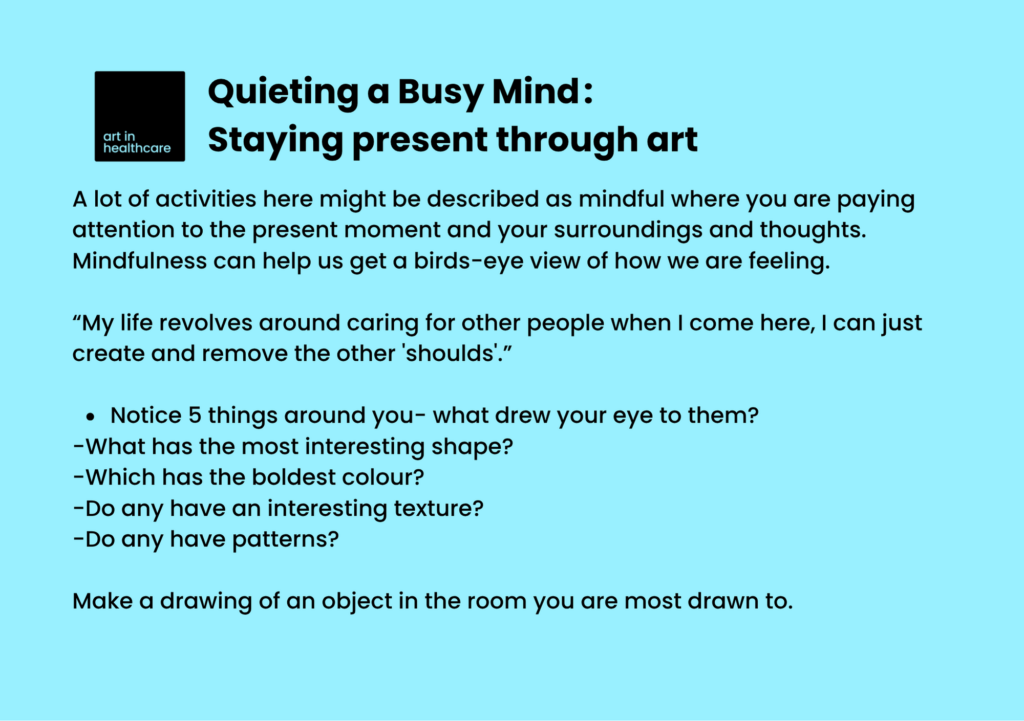
Quieting a Busy Mind: Staying present through art

A lot of activities here might be described as mindful where you are paying attention to the present moment and your surroundings and thoughts. Mindfulness can help us get a birds-eye view of how we are feeling.
 
“My life revolves around caring for other people when I come here, I can just create and remove the other 'shoulds'.” 

Notice 5 things around you- what drew your eye to them?  
-What has the most interesting shape? 
-Which has the boldest colour? 
-Do any have an interesting texture? 
-Do any have patterns? 

Make a drawing of an object in the room you are most drawn to.
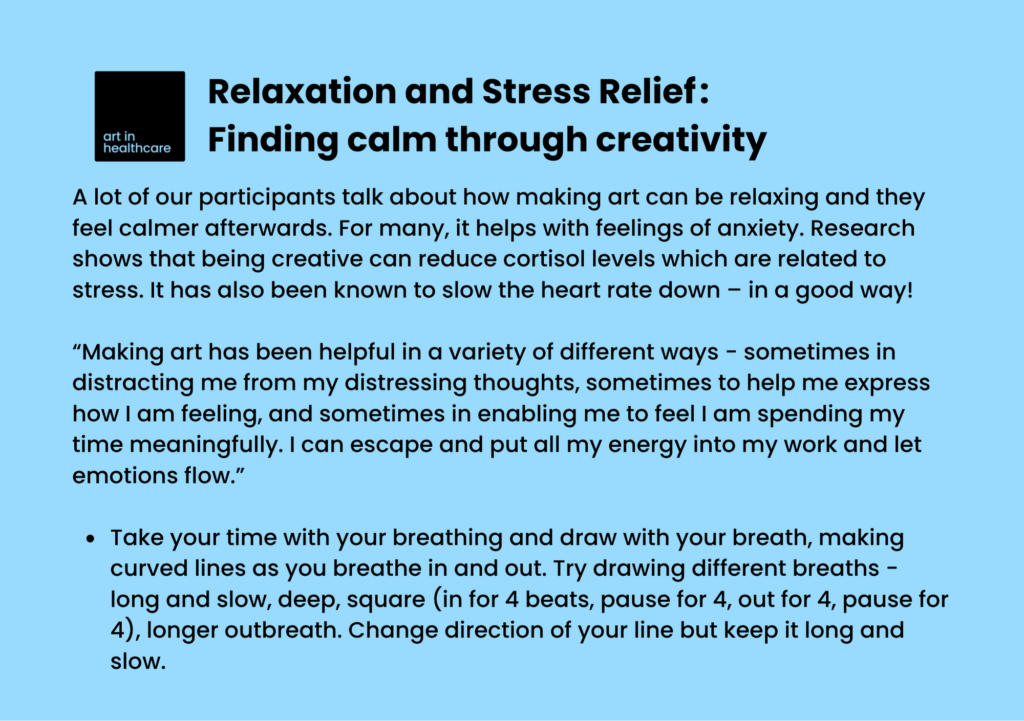
Relaxation and Stress Relief: Finding calm through creativity

A lot of our participants talk about how making art can be relaxing and they feel calmer afterwards. For many, it helps with feelings of anxiety. Research shows that being creative can reduce cortisol levels which are related to stress. It has also been known to slow the heart rate down – in a good way! 

“Making art has been helpful in a variety of different ways - sometimes in distracting me from my distressing thoughts, sometimes to help me express how I am feeling, and sometimes in enabling me to feel I am spending my time meaningfully. I can escape and put all my energy into my work and let emotions flow.” 

Take your time with your breathing and draw with your breath, making curved lines as you breathe in and out. Try drawing different breaths - long and slow, deep, square (in for 4 beats, pause for 4, out for 4, pause for 4), longer outbreath. Change direction of your line but keep it long and slow.
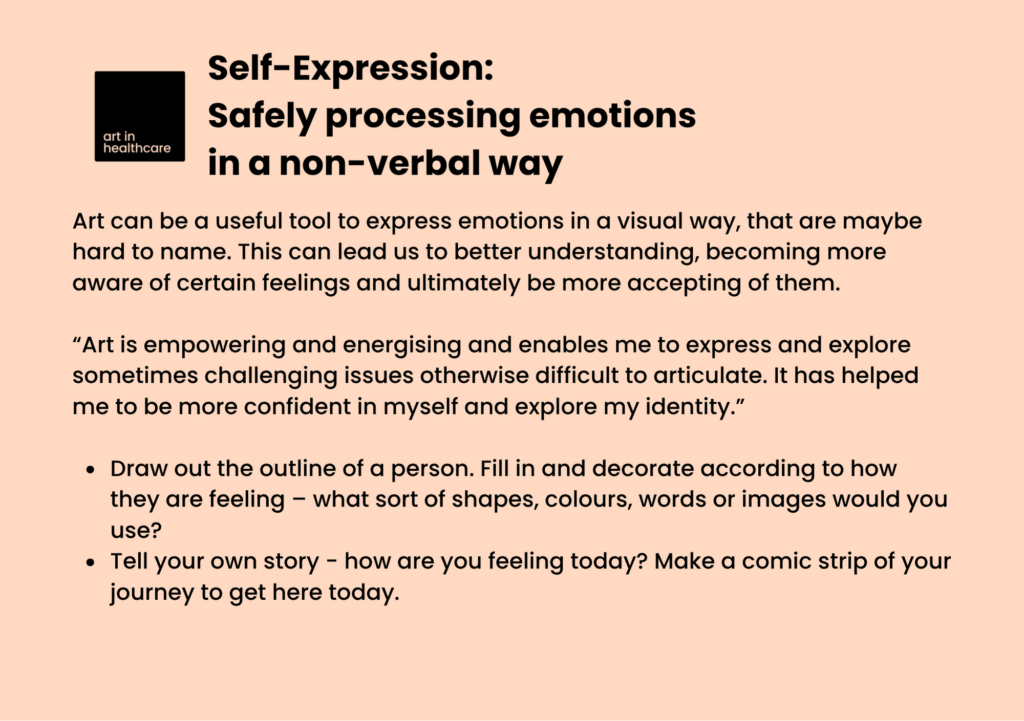
Self-Expression: Safely processing emotions in a non-verbal way

Art can be a useful tool to express emotions in a visual way, that are maybe hard to name. This can lead us to better understanding, becoming more aware of certain feelings and ultimately be more accepting of them.
  
“Art is empowering and energising and enables me to express and explore sometimes challenging issues otherwise difficult to articulate. It has helped me to be more confident in myself and explore my identity.”
 
Draw out the outline of a person. Fill in and decorate according to how they are feeling – what sort of shapes, colours, words or images would you use? 

Tell your own story - how are you feeling today? Make a comic strip of your journey to get here today.
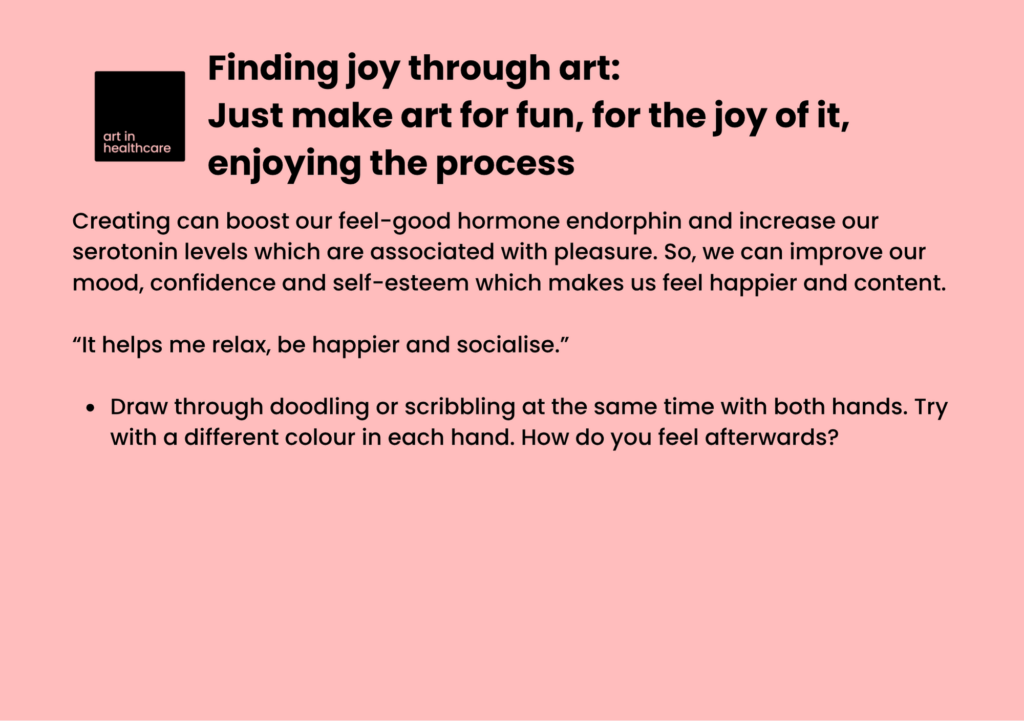
Finding joy through art: Just make art for fun, for the joy of it, enjoying the process.

Creating can boost our feel-good hormone endorphin and increase our serotonin levels which are associated with pleasure. So, we can improve our mood, confidence and self-esteem which makes us feel happier and content. 

“It helps me relax, be happier and socialise.” 

Draw through doodling or scribbling at the same time with both hands. Try with a different colour in each hand. How do you feel afterwards?
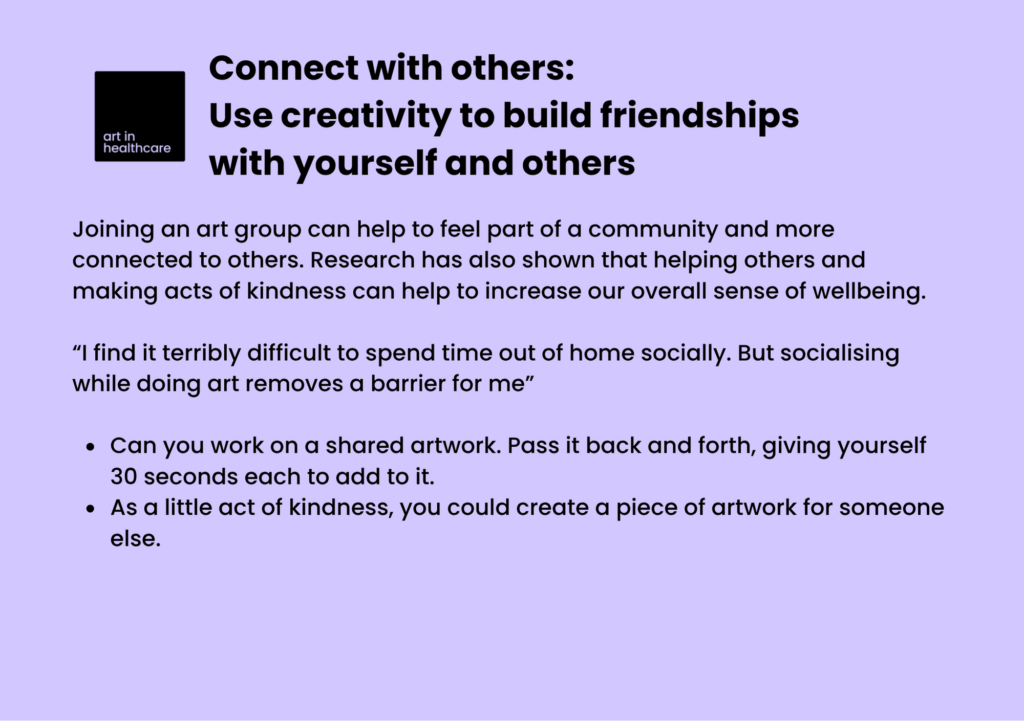
Connect with others: Use creativity to build friendships with yourself and others.

Joining an art group can help to feel part of a community and more connected to others. Research has also shown that helping others and making acts of kindness can help to increase our overall sense of wellbeing.

“I find it terribly difficult to spend time out of home socially. But socialising while doing art removes a barrier for me” 

Can you work on a shared artwork. Pass it back and forth, giving yourself 30 seconds each to add to it.  

As a little act of kindness, you could create a piece of artwork for someone else.

22 April 2026 by

Amy Miles